




Flakon and the environment

Environmental sustainability is a topical issue and a source of concern for many: whether for individuals or businesses, environmental responsibility has become a major priority in consumer behaviour. It has also become a core value for many companies, which express their commitment to sustainability and respect for the environment for both ethical and strategic reasons.
Flakon is no exception: our values centre on learning about wine and, like our partner winegrowers, we have seen and learnt what irresponsible, intensive and unchecked viticulture can lead to. Like our partner winegrowers, we have seen the vastly better fruit produced by tending vines with respect for the terroir and the plants themselves. We want to introduce you to a heritage rooted in quality rather than quantity, and in the respect for nature demanded by a craft born of the perfect harmony between the gifts of the earth and the winegrower’s skill.
Our winegrowers: a tradition that demands respect for the vines
We work with 22 partner wine estates, representing an incredible range of backgrounds and sizes. But they all have one thing in common: a love of winegrowing and winemaking traditions. Those traditions are incompatible with intensive farming: to get the best from grapes, you must not ask too much of the vines.
This is particularly true of French wine: quality is guaranteed first and foremost by an appellation, which, for the most prestigious wines, is restricted to very small, highly protected areas. You cannot exhaust the land through intensive farming without risking the loss of the appellation. Nor can you extend the vineyard beyond its boundaries, because the climate and terroir would change, and so would the appellation. French viticulture therefore naturally avoids overexploitation, at least in quality terroirs, precisely to preserve that quality for the long term.

At least 86% of our winegrowers practise sustainable farming according to their certifications. In practice, this means respecting the ecosystems of their estates and working in harmony with them, producing wine without intensive methods, favouring fertilisers and plant protection products of natural origin, and prioritising manual work to avoid pollution and damage to ecosystems (removing stones, maintaining ground cover, harvesting, etc.). All are committed to a gradual transition towards the most responsible viticulture possible, and 20% are already certified organic or biodynamic.
Furthermore, the three estates without any sustainability certification do not practise irresponsible viticulture. They are small independent producers who care about making quality wines and respecting their vines, but cannot yet afford the investment required to obtain demanding certifications.
Click here to discover our wines and what makes them special!
Vials: 30% less material

The vials we use to store wine are made from much thinner glass than traditional bottles. Although thicker glass offers greater strength, a conventional 75 cl bottle of wine requires 500 grams of material, whereas our vials need only 350 grams of glass to hold the same amount.
Find out more about the vials here!
Gift boxes: 100% recyclable decorative items
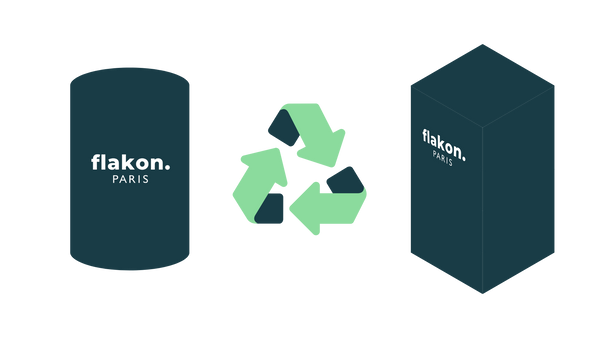
We designed our gift boxes to be kept as decorative items, just as you might keep an empty bottle of fine whiskey and its presentation box. Whether as a collector’s delight or a wine lover’s keepsake, our gift boxes are made for you to keep. And if you ever (ever) want to get rid of them (much to our dismay), they are fully recyclable because they are made from 100% cardboard.
Protective packaging: don’t throw anything away!

Not sure what to do with the protective packaging and cardboard? Don’t throw them away! Recycle your boxes and packaging to create a makeshift wine cellar (assuming you have a storeroom or garage but no storage racks). Take your boxes (each should normally hold one bottle) and ideally raise them off the floor, on a pallet or several pallets, for example. Place a large flattened box on top and secure it to the pallet. Glue the individual boxes to it, laid flat with all their openings facing the same way. Then add a second row above the first, staggering the boxes to stabilise the structure, as you would stack blocks to build a wall. Glue this row too, and glue all adjacent boxes to one another, not just to the row below. You should end up with a pyramid-shaped cardboard structure with a compartment for each bottle, protected by the anti-breakage packaging. Place it against a wall to avoid any nasty surprises (a dry wall, that is).

If you have more bottles than compartments — likely unless you have lots of individual boxes or have bought lots of Flakon gift boxes (thank you!) — put the wines you’ll drink first in your cardboard cellar (no pun intended), particularly those nearing their peak drinking window, and leave the wines that need more time to age in their cases or boxes. There you go! Nothing goes to waste!


